

The MQL vs SQL issue revolves around readiness; a marketing qualified lead (MQL) is a lead that has shown enough interest so marketing is willing to pursue them, whereas a sales qualified lead (SQL) is a lead that has been determined by sales to be ready for a conversation with a representative.
But MQL vs SQL is not just two different labels. It is a very important decision regarding which leads will receive salespeople’s attention and at what moment in the process.
This guide will explain what are MQL and SQL, how an MQL turns into an SQL, why teams may have disagreements on where to place the border between these stages, and how SaaS companies implement the MQL/SQL handoff in order not to let potential clients slip through the cracks between marketing and sales departments.
The problem MQL and SQL solve
Marketing produces a large amount of leads. But a sales department can have limited bandwidth for reaching out to leads. There should be a way to determine whether a particular lead is worth reaching out or not.
MQL and SQL represent the two sides of this problem, which arises because passing every single lead to sales is wasteful (salespeople waste their time on not-yet-qualified leads) and delaying every lead until they contact you is not effective either (leads get cold in the meantime).
The MQL/SQL distinction aims to route the right leads to salespeople at the right moment.
In other words, an MQL means that this particular lead looks promising according to marketing department’s criteria and is ready to go to the sales department to be further evaluated there. An SQL means that this lead has been accepted by the sales department as something worth their attention.
As we can see, the handover between these two phases is where quite a lot of revenue is generated since that is where marketing’s judgment and sales’ judgment meet and do not always coincide.

What is a marketing qualified lead (MQL)?
A marketing qualified lead is a lead that meets whatever requirements a marketing team has decided to establish for a lead in order for it to become a good candidate for passing to the sales department.
Traditionally, the criteria for becoming an MQL were based on the interaction with marketing: downloading a whitepaper, attending a webinar, signing up for a newsletter and so on. The idea behind such MQL criteria was that a person who shows interest in marketing efforts is showing their intent of buying your services/products.
The problem with this type of MQL criteria is that even if a lead interacts a lot with marketing material and is very interested in it, this does not necessarily mean that they want to buy anything. Therefore, marketing teams started to base their MQL definitions on behaviors of actual intention to buy.
What is a sales qualified lead (SQL)?
A sales qualified lead is a lead that has been assessed by the sales department and found to be worth actively pursuing.
The main difference between MQL and SQL is the entity that qualifies a lead. While a lead becomes an MQL if it meets marketing’s criteria, it becomes an SQL if it passes sales’ examination.
An MQL turns into an SQL when a salesperson determines that a lead is worth following up. This decision usually involves checking the things that marketing cannot see themselves: does the lead have budget, authority, need and timeline?
As you can see, while an MQL can meet the requirements of MQL criteria and therefore be qualified as an MQL, the same lead may turn out to be a bad fit for an SQL and thus rejected by salespeople.
In a sense, the SQL stage can be considered as quality control of the MQL. It is needed due to the fact that marketing and sales departments evaluate a good lead from different perspectives. And a lead handover requires a point where salespeople confirm the worthiness of a particular lead for further efforts of the sales team.
When that checkpoint works correctly, salespeople spend their time on the leads that they believe in. When it does not, either salespeople ignore MQLs and lose good opportunities or chase the bad ones wasting their time.
How a lead moves from MQL to SQL
The transition between these two stages is where the process gets really interesting, and it is not always a straightforward one.
A lead starts as an MQL once it meets marketing criteria for becoming an MQL. Then, a few things happen to this lead. Either a lead is reviewed and approved as an SQL, meaning that a lead is worth working on now, or a lead is reviewed and rejected as not ready yet.
Moreover, a lead may turn out to be not ready and go to lead nurturing to be warmed up until it becomes ready.
This step of the process is important since not every MQL is ready to become an SQL. Forcing them all into the direction of an SQL will create the same problem that was solved by introducing MQL criteria – too many unready leads will overload the sales department. Instead, the MQLs that are not ready should be passed to lead nurturing where they will build up their intent of buying something and then become an SQL.
Therefore, the process is not MQL -> SQL. Rather, it is MQL, then SQL or nurturing or disqualified.

Where lead scoring fits in
There is a certain distinction that is important to be clear about, and is often misunderstood.
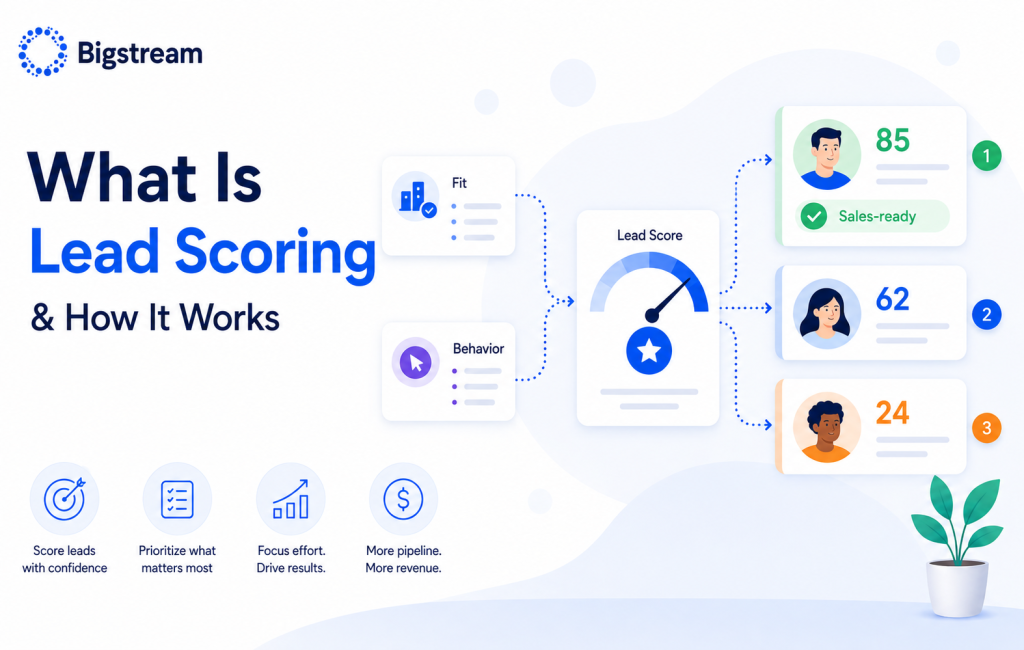
MQL and SQL are stages, they indicate where a lead is in the qualification process. Lead scoring is the process of determining if the lead meets requirements to go from one stage to another. These two concepts are different, and confusion of them leads to confusion in understanding the process as a whole.
Scoring works by assigning points to the signals that predict a good customer and summing them into a total. When that total crosses a threshold, the lead is flagged as ready to move forward, from raw lead to MQL, or from MQL to SQL. In other words, the MQL/SQL boundaries are lines, and scoring is how you decide which side of the line a given lead is on.
This is why the two ideas are so often discussed together. You cannot operate MQL and SQL stages at any scale without some system for deciding who qualifies, and that system is scoring. A team that defines MQL and SQL but has no consistent way to score leads ends up making the call by gut feel, which is inconsistent and does not scale. A team with automated lead scoring has a repeatable, inspectable rule for who crosses each line, which is what makes the whole MQL/SQL framework actually work rather than just describe.
The important thing is to keep the roles clear: MQL and SQL are the stages, scoring is the engine that moves leads between them.
Why teams argue about where the line sits
If MQL and SQL are so useful, why do teams often struggle with them?
First of all, because MQL and SQL definitions are established by entities with conflicting goals. And the boundary between them is debatable.
Generally speaking, marketing is evaluated by the volume of MQLs. So, there is an incentive for defining MQL criteria as wide as possible. On the other hand, sales teams are evaluated by the number of closed deals. Therefore, there is a desire to accept only the leads which are obviously ready. Thus, left unattended, these incentives pull in different directions, leading to flooding of the sales department by MQLs and subsequent rejection of most of them by salespeople.
Of course, this problem has its solution. It lies in the agreement of both teams.
Teams that work successfully with MQL/SQL handovers discuss MQL/SQL criteria with each other and determine explicitly the requirements to be met by the leads in order to be an MQL and what the salespeople will do with this leads once they received an MQL.
Thus, MQL/SQL handover is based on the shared agreement between these two teams, which sometimes is even formalized as a service-level agreement. This is how a contested MQL/SQL boundary turns into an effective handover mechanism.
Without such an agreement, MQL and SQL are merely labels interpreted in different ways by marketing and sales respectively. With it, MQL/SQL becomes the real routing system which passes the right leads to salespeople at the right time.
How SaaS companies implement MQL/SQL handover
There are a few common features in implementing the MQL/SQL handover by a SaaS company.
First of all, it is based on behavioral signals rather than content engagement. Since product usage gives much more information about the lead’s intent than attending webinars, MQL criteria in SaaS are usually based on the lead’s actions in the product, such as activation of the account, invitation of teammates, meeting a certain level of product usage.
Secondly, the MQL/SQL handover is conducted in a consistent way, using a lead scoring rule. It means that every MQL is scored according to this rule, and both teams know why this or that lead has been qualified.
Thirdly, the handover is automatic and fast. A sales-ready lead should be routed to the right representative as quickly as possible because its readiness has a limited lifetime. Since these processes are repetitive and time-sensitive, marketing automation for SaaS helps manage them efficiently.
Moreover, rejections of MQLs by salespeople are used as feedback to fine-tune MQL criteria.
In other words, MQL/SQL is a joint decision of marketing and sales rather than a mere marketing metric.
How to Think About MQL and SQL
Thinking of MQL/SQL in terms of the decision of both departments regarding the readiness of a lead is the best way to approach this issue.
Otherwise, the MQL becomes a vanity number that grows bigger while sales ignore it. But treated as the joint agreement with the consistent criteria, MQL and SQL become what they are supposed to be – the routing system that ensures that your best leads reach a salesperson at the best time.
Define the criteria explicitly, use consistent lead scoring and quick handover mechanism, and the gap between marketing and sales where potential customers usually get lost will simply disappear.
Frequently asked questions
What is the difference between an MQL and an SQL?
An MQL (marketing qualified lead) is a lead that has met marketing’s bar for interest and is passed along as promising. An SQL (sales qualified lead) is a lead that sales has examined and judged worth actively working. The difference is who qualifies them: MQLs are qualified by marketing’s criteria, SQLs by sales’ judgment, which usually adds checks like budget, authority, need, and timeline.
How does a lead become an SQL?
A lead usually enters as an MQL, then sales (or a sales-defined rule) reviews it. If sales agrees it is worth pursuing, it becomes an SQL. If not, it is either sent back to marketing for nurturing until it is ready, or disqualified. The transition is a filter with feedback, not an automatic promotion.
What is the difference between MQL/SQL and lead scoring?
MQL and SQL are stages that describe where a lead is in qualification. Lead scoring is the mechanism that decides when a lead crosses from one stage to the next, by summing points for predictive signals and comparing the total to a threshold. Scoring draws the line; MQL and SQL are the two sides of it.
Why do marketing and sales disagree about MQLs?
Because they are measured differently. Marketing is often judged on MQL volume, which pushes toward loose definitions, while sales is judged on closed deals, which pushes toward rejecting all but the strongest leads. The fix is a shared, explicit definition of what counts as an MQL and what sales commits to doing with one, agreed by both teams.
What makes a good MQL in SaaS?
In SaaS, behavioral signals predict intent much better than content engagement. A lead who has started a trial, activated the product, invited teammates, or hit a usage limit is a far stronger MQL than one who merely downloaded guides or attended a webinar. The best MQL definitions weight real product behavior over passive marketing engagement.

Vasyl Popovych has six years of experience in link building and off-page SEO, helping businesses grow their organic visibility and domain authority. At Bigstream, he works on AI marketing automation for SaaS companies, from lead nurturing and onboarding to churn prevention. He writes about lifecycle marketing and the automation that actually moves revenue.