

Trial-to-paid conversion is the percentage of free trial users who become paying customers, either during the trial or shortly afterwards. For a SaaS company that runs on trials, it is the point where the money spent on acquisition turns into recurring revenue, so even a small improvement moves everything downstream.
This guide describes how to calculate trial-to-paid conversion properly, why most SaaS trials do not convert, and eight tactics that move the number. At Bigstream, we build AI marketing automation for SaaS teams, and a large part of that work is the trial and onboarding flow, so the advice below reflects how these systems are put together. If you want the foundation first, start with what customer onboarding means in a SaaS product, because most trial conversion work is onboarding work.
What trial-to-paid conversion measures
The trial-to-paid conversion formula is simple:
Trial-to-paid conversion rate = (trial users who became paying customers ÷ trial users who started in the period) × 100
Here is an example with made-up numbers, not a benchmark: 500 people start a free trial in March. By the end of April, 60 of them have become paying customers. The trial-to-paid conversion rate for March is 60 ÷ 500 × 100 = 12%.
Several details make the metric either meaningful or misleading:
- Calculate by trial start cohort. Group users by the month (or week) they started the trial and count how many of them converted. Dividing this month’s new payers by this month’s trial starts mixes users from different cohorts, and the rate moves with every increase or decrease in traffic.
- Define the conversion window. Some users pay on the last day of the trial, others a week later after a reminder. Set a fixed window, for example “paid within 14 days after the trial ended”, and use it for all calculations so cohorts are comparable.
- Define who goes into the denominator. Spam sign-ups, internal test accounts and duplicates should be excluded. Otherwise they lower the rate and mask real changes.
- Separate trial types. If you run card-required and no-card trials, or different trial lengths, track them separately. Their rates behave differently, and mixing them hides insights.
There is no universal benchmark for a “good” trial-to-paid conversion rate. It depends on your price point, your audience, whether the trial requires a credit card, and how well your sign-ups match your product. Use your own past cohorts as the comparison, not a number from someone else’s post.

Why most trials do not convert
Understanding why most SaaS trials do not convert helps you choose the tactics to change that. Non-converting trials usually fall into four groups:
- They never activated. The user signed up but never reached the moment where the product helped them solve a problem. This is usually the largest group, and the one where you can influence the most.
- They activated too late. They got value, but only towards the end of the trial, or after their attention had shifted elsewhere.
- They were a poor fit. Some sign-ups would not convert anyway: students, competitors, people browsing the category, companies too big or too small for your product. This is a matter of better targeting upstream, not of trial tactics.
- They hit friction at the decision stage. The user liked the product but stumbled on pricing, plan selection, procurement or a missing integration.
The first two are onboarding problems, the third is a targeting problem, and the fourth is a decision-flow problem. The tactics below mostly address the first, second and fourth.
Tactic 1: Define activation and track it
Trial conversion is the metric you optimize, but activation is the leading indicator. Users who reach the activation event during the trial are generally much more likely to pay than those who do not, and you can track it earlier than payments.
Choose the event that shows the user has received value from the product: connected a data source and generated a report, created a project and invited a teammate, sent a first campaign. The best way to find it is to compare paying users with users whose trials expired and look for the action that clearly separates them. It will not be perfect, but it is better than a guess.
Then track two metrics for every trial cohort: the activation rate, and how long it took users to activate. If the activation rate is low, nothing will help except raising it, so fix that before working on the copy at the end of the trial.
When I review a trial funnel, I pay special attention to whether the activation event is really related to the problem the product solves. For a reporting tool, for instance, opening the dashboard tells me less than generating a report from connected data, so I would compare the two events across paid and expired trial cohorts. I also check how quickly each event is reached, because an activation that happens right before the trial deadline leaves no time to build a habit.
Tactic 2: Reduce time to value
Every additional step between sign-up and first value is another chance for the user to drop out of the trial. Time to value is the delay between account creation and reaching the activation event, and reducing it is often one of the most effective changes you can make.
Some practical ways to do it:
- Remove or postpone sign-up steps and settings that are not required to reach first value.
- Give users sample data or a template so they can see the product working before they connect their own data.
- Set default values wherever possible and make the first action obvious on the first screen.
- Create an account in your own product as a brand-new user and count the steps to the activation event. Is each step necessary for getting value?
Aim to get users activated in the first session, because many never come back for a second one.
Tactic 3: Choose the right type of trial
The type of trial influences who signs up and how many of them convert. The options come with trade-offs rather than a clear winner:
- No-card free trial. Lower barrier, so you get more sign-ups, including many casual ones. The conversion rate per sign-up tends to be lower, but the volume of trials can compensate.
- Card-required free trial. Fewer people start, but those who do are more serious, and conversion per trial is often higher. The risks are friction at sign-up and unhappy users when the first charge arrives, which can lead to refunds and churn.
- Freemium. Users stay on a limited free plan indefinitely. It builds a large user base and works when value grows with usage, but it needs clear triggers for conversion.
- Reverse trial. Users get full access for a limited time and then move to a free plan. This keeps them in the product after the trial and gives you more time to convert them.
Trial length matters as well. A trial should be long enough for a typical user to reach the activation event and see how the product helps in their real situation, and short enough to keep urgency. If your product needs a week to show value but your trial lasts seven days, many users will never get there. Analyze how long your converting users needed to activate and set the trial length accordingly.
Tactic 4: Run a trial email sequence
Users are not in your product most of the time, so email is how you bring them back. A trial email sequence works on two levels.
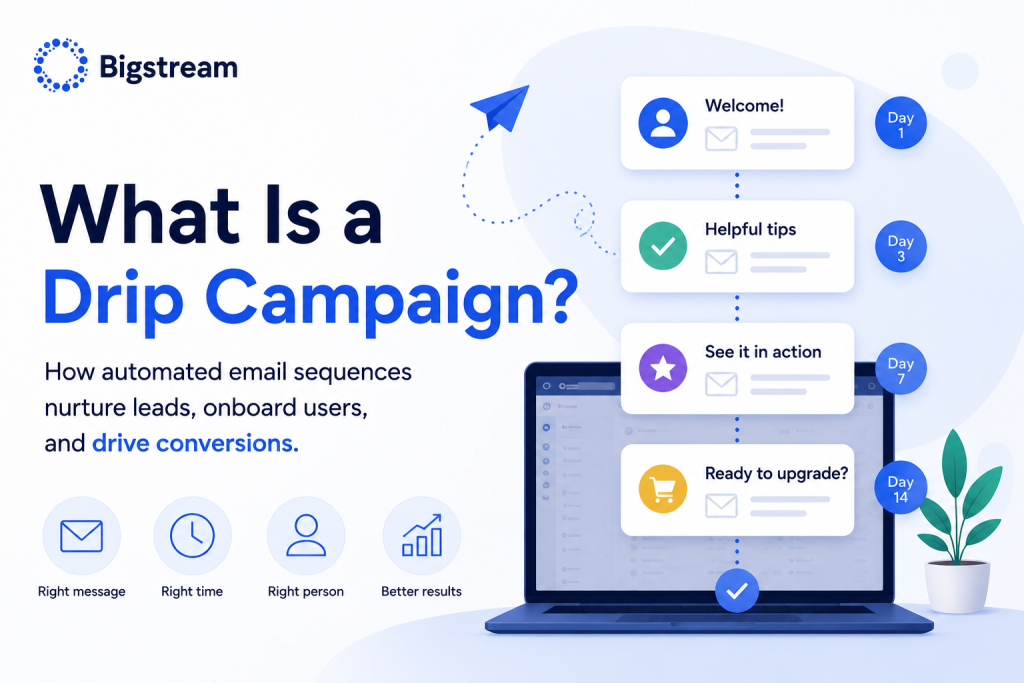
The first is a time-based drip campaign: a fixed set of messages sent on fixed days after sign-up. It is easy to implement and reliable. Common messages are a welcome with the most important first step, a brief guide to the next step, an example of how the product is used, and reminders as the end of the trial approaches.
The second level is trigger-based messaging, where the email depends on what the user has or has not done. Users who completed setup get guidance toward the next valuable action. Users who have not logged in for two days get a brief reminder with a link to where they left off. Users who reached the activation event get information about plans and what upgrading unlocks.
Here is an illustrative structure of how the two levels can be combined. The timings are an example to adapt to your product, not a recipe for everyone:
| Moment | Trigger | Goal of the message |
|---|---|---|
| Sign-up | Account created | Welcome and one important first step |
| Day 1, not activated | No activation event | Remove the most common obstacle, link to the exact step |
| Day 3 | Time-based | Show a specific use case |
| Activated | Activation event | Reinforce the win and suggest the next action |
| Mid-trial | Time-based, depending on activity | Active users: depth. Inactive users: restart or help |
| 3 days before the end | Time-based | Recap what they accomplished, explain what happens next |
| Last day | Time-based | Clear call to upgrade, with a simple path to do it |

Every message should have one goal and one call to action. A trial email that tries to explain five features rarely achieves anything.
Tactic 5: Guide users inside the product
Email works when users are away from your product, but most of the conversion work happens while they are in it.
An onboarding checklist that shows progress toward the activation event is one of the most reliable tools. Empty states that explain the first step instead of a blank screen, tooltips on the first use of a key feature, and a setup wizard for complex products all help in the same way: they reduce the effort of the next step.
In-product prompts should match the email sequence. If your email says “connect your data source”, make that the most prominent action inside the product when the user logs in. A mismatch between the two channels causes confusion and slows users down.
Tactic 6: Identify high-intent trials and add a human touch
Not every trial user needs the same treatment. Some show strong purchase intent: they invite teammates, use the core features repeatedly, visit the pricing page, and use the product on real tasks instead of just exploring it. These users are often called product-qualified leads.
For them, a short personal email from someone on your team, an offer of a setup call, or a quick answer to a question about price or security can help much more than another automated email. This is particularly true for higher-priced plans that need a joint decision from a whole team.
Automation helps identify these users early, so a person can reach out while they are still engaged. The human step stays human, but no strong trial goes unnoticed because someone was busy.
Tactic 7: Make the end of the trial smooth
Many trials are lost in the last few days, not because of the product but because the end of the trial was unclear.
- Remind users before the trial ends and say what happens next. Nobody should be surprised by the first charge or by losing access.
- Recap their progress. A message like “here is what you have set up and what you would lose” is much more convincing than a discount code, because it is specific to the user.
- Make upgrading easy. Link directly to the right plan, preselect the most likely one, and remove unnecessary steps in checkout.
- Offer a limited extension to users who activated late. If someone reached the activation event on day 12 of a 14-day trial, an extension gives them time to use the product.
- Cover the typical blockers in the email. Price, contract terms, team seats and missing integrations are predictable. Address them directly or offer a way to ask questions.
Tactic 8: Follow up with trials that did not convert
An expired trial does not mean the user is gone. Many people were not ready, were waiting for budget, or simply got busy.
A follow-up sequence after the trial ends can recover some of them: a short message asking what stopped them (a one-question survey is enough), a message with a useful resource, and a later message if there is an update in the product. Messages to users who activated should differ from messages to those who did not.
The answers to “why have you not upgraded?” are valuable too. They show whether the reasons are price, poor fit, missing features or an unclear value, and they point to what to improve next.
How to measure and improve trial-to-paid conversion
Improving trial conversion is an iterative loop of measuring, changing and measuring again.
Track the following for every trial cohort:
- Trial starts and the share of qualified trials
- Activation rate and median time to activation
- Trial-to-paid conversion rate within the chosen window
- Conversion rate by source, plan and customer segment
- Time from trial start to first payment
Test one major element at a time, such as the first email, the trial length or the onboarding checklist, so you can isolate what changed the metric. If the number of trials is small, treat the results as directional, not conclusive: a few extra conversions in a month can be noise. Wait for several cohorts before drawing conclusions.
One change I would test is replacing the universal day-two reminder with a message that is sent only when setup is not completed and that links to the incomplete step. Then I would compare the activation rate and median time to activation in subsequent cohorts, rather than using open rates as evidence that onboarding works.
Common mistakes
- Optimizing the end of the trial while the activation rate is low. Reminders and discounts cannot help users who never activated.
- Sending the same sequence to everyone. Active and inactive users need different emails.
- Measuring by calendar month instead of by trial cohort. It makes the metric depend on swings in traffic.
- Setting the trial too short for your product. Users simply do not have enough time to activate.
- Treating every sign-up as equally valuable. Poor-fit sign-ups drag the conversion rate down, and the fix is upstream, in attracting the right audience.
- Putting too many offers in one email. One goal and one call to action per email.
- Ignoring users who did not convert. They are a source of late conversions and product feedback.
Where automation helps
Almost everything above is repetitive, time-sensitive and rule-based: send this email if the user has not activated yet, branch the sequence by activity, flag accounts with strong signals, remind before the trial expires. That is exactly the kind of work that should be automated, so no trial slips through because of a missed reminder.
Instead of building and maintaining that machinery yourself, Bigstream sets up onboarding automation for SaaS companies on the tools you already use. Schedule a call and we will start from your own trial data.
Frequently asked questions
What is trial-to-paid conversion?
It is the percentage of free trial users who become paying customers during the trial or within a set timeframe after it. The formula is (trial users who became paying customers ÷ trial users who started in the period) × 100.
What is a good trial-to-paid conversion rate?
There is no universal number. It depends on your price point, target audience, whether a credit card is required to sign up, and how well your sign-ups match your product. The best comparison is your previous cohorts: are things getting better, and is the conversion rate high enough to justify your customer acquisition costs?
How long should a SaaS free trial be?
Long enough for a typical user to activate and see the product in action, and short enough to create urgency. Check how long your converting users take to activate and set the trial length based on that, rather than on a standard 7, 14 or 30 days.
Should a free trial require a credit card?
It depends on what you want. Requiring a card gives fewer sign-ups but higher intent and can improve conversion per trial, while trials without a card bring more volume and lower intent. Test both for your product and look at conversion and early churn together, since card-required trials can result in unhappy first payments.
What is the difference between a free trial and freemium?
A free trial provides limited-time access, usually to the full product, and ends with a decision to pay. Freemium provides a limited version for free with no expiration date and converts users when they need additional features or capacity.
What is the difference between a free trial and freemium?
A free trial provides limited-time access, usually to the full product, and ends with a decision to pay. Freemium provides a limited version for free with no expiration date and converts users when they need additional features or capacity.
How do you increase trial-to-paid conversion?
Start with activation: define the action that shows value, shorten the time needed to reach it, and guide users with in-app prompts and timely emails. Then handle the end of the trial properly, add human outreach for high-intent users, and follow up with those who did not convert.
How is trial-to-paid conversion different from lead conversion?
Lead conversion measures how many leads become customers across the whole process, including sales conversations. Trial-to-paid conversion measures just one step: how many users who started using the product decide to pay.

I work on marketing automation for SaaS at Bigstream, building lifecycle workflows for lead nurturing, onboarding, lead scoring, churn prevention and revenue attribution. I focus on a small number of workflows that move real revenue metrics like MRR, trial-to-paid conversion and churn, built on the tools a team already uses. If an automation doesn’t tie back to a metric that matters, it probably shouldn’t exist.