

Customer onboarding is the process of guiding a new user from sign-up to getting actual value from your product. In SaaS, it includes all steps from “I created an account” to “this actually solves my problem”: setup, first actions, helpful messages along the way, and the moment the product becomes a part of the user’s routine.
This article defines onboarding, explains its importance for a subscription business, discusses how to define the target moment of onboarding, and describes how SaaS companies use emails, in-app guidance, and behavioral triggers to get more users there. It is aimed at founders and marketers interested in onboarding that drives activation.
Why onboarding matters more in SaaS
In a traditional purchase, the sale is the finish line. In SaaS, the sign-up is closer to the starting line.
A new trial user hasn’t committed to keep using the product. They have committed to trying it. Whether they continue depends almost entirely on whether they experience value in time: before their attention shifts, before the trial expires, or before the next tool they signed up for this week takes up their time. A product can be great and still lose most of its trial users if they never get far enough to experience its value.
That is why onboarding has such a huge influence on everything that follows. Trial-to-paid conversion depends on it, because users who never reach value rarely pay. Retention depends on it, because a large share of churn traces back to customers who were never properly activated. Expansion depends on it as well, since teams will never increase the usage of a product they haven’t adopted yet.
In short, onboarding is where acquisition money either becomes revenue or disappears. Every user you paid to acquire goes through it.
Onboarding vs lead nurturing
These two processes are often confused, so here is a quick distinction.
Lead nurturing happens before someone becomes a user or a customer. It builds interest and intent until a lead is ready to sign up or talk to sales.
Onboarding happens after sign-up. It turns a new and curious user into an active one who has experienced the value of your product. The audience has already committed to trying. Now the question is whether they will commit to paying.
The two parts are connected and the messages should flow seamlessly, but the goals are different. Nurturing builds intent. Onboarding turns intent into use.

Start with the moment you want to reach
The most common mistake in onboarding is crafting the messages before you decide what onboarding should achieve.
Every product has a moment when a new user first gets the value they signed up for. This is sometimes called the activation event or “aha moment”. It can be creating a project and inviting a teammate in a project management tool, connecting a data source and receiving the first report in an analytics product, or sending the first campaign in an email tool. Whatever it is, it is concrete, observable, and linked to retention.
Defining the moment changes the way you build onboarding. Instead of “send five helpful emails”, the goal becomes “get as many new users as possible to this specific action, as fast as possible”. Every step, every message, and every nudge should be evaluated by one question: does it help users get closer to this moment?
To define it, look at your existing customers. What did the users who stayed and paid do differently from the ones who churned? The action that clearly separates those two groups is most likely your activation event. It won’t be perfect, but it is definitely better than guessing.
One mistake I often see is defining the activation event around an action that is easy to track, but not necessarily linked to value. Finishing the profile or opening the dashboard may be simple actions to track in an automation tool, but they don’t necessarily mean that the user has accomplished something. A better activation event is usually linked to an outcome: completing the first workflow, getting the first useful result, or reaching the point where the product can become a part of the user’s routine.
Time to value: the most important metric
Once you know the moment you’re aiming for, the most important metric to measure is the time it takes new users to reach it. This is time to value.
Shorter is better. Every additional step, every confusing screen, and every day between sign-up and first value is a moment when users drop off. Many onboarding improvements are about removing obstacles, not adding features. This means fewer required fields, better defaults, sample data so the product isn’t empty, and setup steps that can be delayed or skipped.
A simple exercise: sign up for your own product as a new user and count every step from creating an account to reaching the activation event. For every step, ask yourself whether it is truly necessary before users get value, or whether it can be delayed. Most products find steps they can remove or postpone.
The building blocks of SaaS onboarding
Effective onboarding typically involves multiple channels, each playing a different role.
In-app guidance is the channel where most of onboarding happens. Checklists, tooltips, empty states that explain the first steps, and setup wizards help users while they’re inside the product and paying attention. This channel is often the most effective because it helps users at the moment they take action.
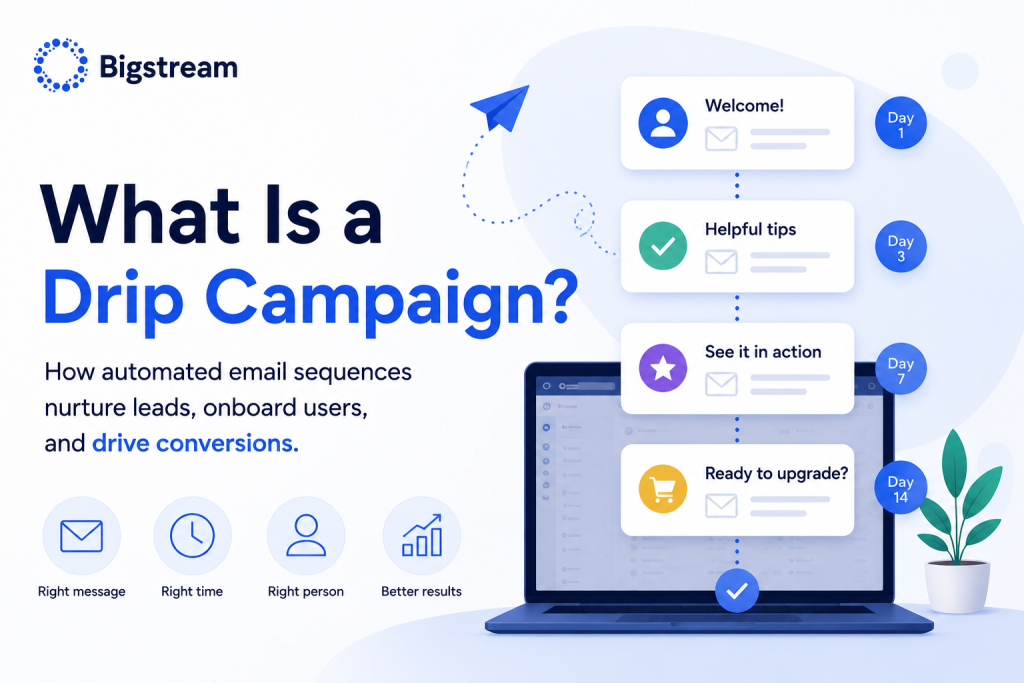
Onboarding emails bring users back when they’re not in the product. Most new users won’t complete the setup process in one session. Emails are how you reach them later: a reminder of where they left off, a short guide to the next step, or a helpful example. The classic version is a scheduled drip campaign, a series of emails sent on fixed days after sign-up.
Behavioral triggers make those emails relevant. Instead of sending the same message on day three to everyone, triggers respond to what each user did or did not do. The user who finished setup gets guidance toward the next valuable action. The user who got stuck on a step gets help with that step. In practice, the best onboarding combines a short baseline sequence with triggers for critical moments.
Human touch is still important, especially for high-value accounts. A short, personal message from someone on the team, an offer of a setup call, or a quick check-in when an important account gets stuck can do what automated sequences cannot. Automation should help identify those moments, not replace them.

Onboarding emails that actually help
Many teams rely on generic content in their onboarding emails. A few simple rules make a huge difference.
Each email should have one purpose: one next step, one call to action. An email that tries to introduce five features usually results in none of them being used.
Focus on the activation event, not the entire feature list. Users don’t need a tour of every feature; they need the quickest path to their first win. Save general feature education for later.
Stop messages once the goal is reached. If a user has completed setup, don’t keep sending “complete your account setup” emails. Suppressing messages once the goal is reached makes onboarding feel attentive, not robotic.
Make the sender human. Plain, short emails from a real person usually feel more helpful than fancy newsletters during onboarding. The tone should be “here is how you get value”, not “here is our marketing”.
Measure behavior, not opens. The success of an onboarding email is whether more users complete the step it targets. Open rates tell you whether the subject line worked, not whether onboarding worked.
How SaaS teams run onboarding at scale
Onboarding is not a one-time build. It is a system that has to run for every new user, every day, and evolve as the product evolves.
That is why automation is a good fit. The logic is clear: detect where each user is in the journey, send the right message at the right moment, stop when they reach the goal, and flag accounts that need human attention. Doing it manually doesn’t scale beyond a few customers, while doing it badly, by sending generic messages on fixed days to everyone, misses most of the potential.
This is the logic behind email and onboarding automation: define the activation event, connect product data to email and messaging tools so triggers can fire from real user behavior, create focused sequences, and measure whether more users reach value. It is one of the most effective parts of marketing automation for SaaS, since every improvement works for every new user who signs up later.
A common problem with behavioral onboarding is that the workflow logic is fine, but the product data is not. Events may arrive late, fire twice, or use inconsistent properties, which means that a user who has already completed a step may still receive a reminder. Before adding more onboarding messages, test the event data end to end and make sure that every trigger, suppression rule, and status update corresponds to what the user actually did.
Common onboarding mistakes
There are a few patterns that repeat themselves.
- No defined goal. Onboarding designed as “a welcome series” instead of targeting a specific activation event is nice but ineffective.
- Too much, too soon. Trying to show every feature in the first session overwhelms new users. Aim for the first win, not a full education.
- One sequence for everyone. Different users have different goals and move at a different pace. One fixed schedule cannot serve them all well.
- Ignoring stalled users. The users who started and then stopped are the ones most worth reaching, but many onboarding sequences treat them the same as everyone else.
- Measuring the wrong thing. Judging onboarding by email engagement instead of activation rate and time to value hides whether it actually works.
Onboarding is the first retention strategy
The best way to think about customer onboarding is as retention that starts on day one. Customers who reach their first value early are much more likely to stay, pay, and expand. Customers who never reach value are already on their way out, even if they churn months later.
Get onboarding right and everything else in the funnel becomes easier: acquisition spend turns into revenue, churn decreases, and the product gets a chance to show its true value. If you treat onboarding as a welcome email and a hope, many of the users you spent money to attract will never discover what your product can do.
Frequently Asked Questions
What is customer onboarding in SaaS?
Customer onboarding is the process of guiding a new user from sign-up to the moment they get their first value from the product. It includes setup, first actions, in-app guidance, onboarding emails, and any human help along the way, with the goal of turning a new user into an active one.
What is an activation event?
An activation event is the specific action that shows a new user has experienced the core value of your product, such as creating a first project, connecting a data source, or sending a first campaign. It is usually defined by comparing the actions of retained users with the actions of churned users.
What is time to value?
Time to value measures how long it takes a new user to get their first value, usually from sign-up to the activation event. Shorter time to value means more users activating and fewer users dropping off during onboarding.
What should onboarding emails include?
Each onboarding email should target one specific next step that gets the user closer to the activation event. The best sequences are short, written in a plain, human tone, stop once the user reaches the goal, and use triggers based on what the user actually did.
How does onboarding affect churn?
A large share of churn comes from users who never fully activated. Users who reach value early are much more likely to stay, while users who get stuck during onboarding often churn later, even if they cancel months afterwards.

I work on marketing automation for SaaS at Bigstream, building lifecycle workflows for lead nurturing, onboarding, lead scoring, churn prevention and revenue attribution. I focus on a small number of workflows that move real revenue metrics like MRR, trial-to-paid conversion and churn, built on the tools a team already uses. If an automation doesn’t tie back to a metric that matters, it probably shouldn’t exist.